Jun
29

Credit Counseling Requirements

To qualify for bankruptcy, you must show that you received credit counseling from an approved provider within the 180 day period prior to the filing of your petition. Fortunately, this requirement can be met not only in person but by phone and even online. Once you complete the counseling, the agency will email or fax you a certificate showing that you completed the requirement. If you are represented by an attorney, you will want to make sure that the attorney receives a copy of the certificate for filing.

The purpose of credit counseling is to give you an idea of whether you really need to file. Though the agency may make a proposal to you regarding a repayment plan, you are free to discard the agency’s suggestion.

Jun
29

The Chapter 7 Trustee

As a Chapter 7 filer you will only on the rarest of occasions come before an actual bankrutpcy judge. The bankruptcy court exercises its control over your case through a person called a trustee who is appointed by a branch of the Department of Justice called the Office of the United States Trustee.

The chapter 7 trustee’s primary duties are as follows
+ Read the full Entry

Jun
26

Protection for the Non-Filing Spouse or Co-Debtor

When an individual files for bankruptcy they may have obtained a loan with a friend or family member. By doing this, they are on the loan together. In Bankruptcy, if the debtor is on a loan with another person who has not chosen to file bankruptcy; the non-filing person obtains the same benefits of the protection of the bankruptcy case as the debtor that did file from that particular creditor. After someone files for bankruptcy the protection from creditors is automatically put into place. This protection prevents any creditors from collecting or taking any action to secure their interest on a loan against the bankruptcy filer. At the same time, this protection is extended to a non-bankruptcy filer as well. This is a very generous benefit that a co-signor has even when they have not filed for bankruptcy. However, this benefit is not as far reaching as it may seem. When a person files for bankruptcy they are either trying to reorganize their debts by making a monthly payment under Chapter 13, or they are seeking a completed discharge of their debts subject to the liquidation of their assets under Chapter 7. In either case, if the individual that filed for bankruptcy cosigned a loan with another party that has not filed for bankruptcy, both will be protected from any collection efforts. However, if the individual that filed for bankruptcy decides to return the item back to the creditor or defaults on the loan while in bankruptcy that the non-filer cosigned a loan for, then the non-filer is no longer protected and the creditor can start making collection attempts against the non-filer. Unfortunately, the non-filer will be on the hook unless he or she files a bankruptcy themselves, whereas the filing party receives the benefit of a complete discharge of the debt if they defaulted on the loan.   

Jun
08

Can I Lose My Discharge after My Case is Done?

The court may revoke a discharge under certain circumstances. For example, a trustee, creditor, or the U.S. trustee may request that the court revoke the debtor’s discharge in a chapter 7 case based on allegations that the debtor: obtained the discharge fraudulently; failed to disclose the fact that he or she acquired or became entitled to acquire property that would constitute property of the bankruptcy estate; committed one of several acts of impropriety described in section 727(a)(6) of the Bankruptcy Code; or failed to explain any misstatements discovered in an audit of the case or fails to provide documents or information requested in an audit of the case.

Typically, a request to revoke the debtor’s discharge must be filed within one year of the discharge or, in some cases, before the date that the case is closed. The court will decide whether such allegations are true and, if so, whether to revoke the discharge.

+ Read the full Entry

Jun
07

When Can I File Again?

During these troubled economic times in both Oregon and Washington, we are seeing more and more people being forced into bankruptcy for the second or third time of their lives. Unfortunately, the new bankruptcy laws place some fairly severe limitations on a debtor’s ability to refile.

+ Read the full Entry

Jun
07

The Bankruptcy Judge

The court official with the power to make final decisions in either an Oregon or Washington bankruptcy case is the United States bankruptcy judge, a judicial officer of the United States district court. The bankruptcy judge may decide any matter connected with a bankruptcy case, such as eligibility to file or whether a debtor should receive a discharge of debts. Much of the bankruptcy process is administrative, however, and is conducted away from the courthouse. In cases under chapters 7 and 13, this administrative process is carried out by a trustee who is appointed to oversee the case.

+ Read the full Entry

May
26

Cars and Bankruptcy in Oregon and Washington

In figuring out what to do with a car in bankruptcy, the most important issue is, not surprisingly, the value of the car. Once you determine the private party Kelley Blue Book value of the car, the next step is determining the amount of your equity. If you subtract the amount that you owe on the car from the private party value of the car that will give you a good idea of what your equity is in that vehicle. In most cases, you can protect your car using the allowable bankruptcy code exemptions.  The bankruptcy courts in both Oregon and Washington understand you need a car to get to work and to pick your kids up from school. So long as you aren’t driving an antique classic car, you will likely be able to keep it.  

If you live in Washington, you will most likely be able to claim either the Washington State Bankruptcy Exemptions or the Federal Bankruptcy Exemptions in order to protect your car. In Oregon, you will most likely be limited to the Oregon Bankruptcy Exemptions. Regardless of whether you live in Oregon or Washington, your car is likely protected.

+ Read the full Entry

May
23

About Me

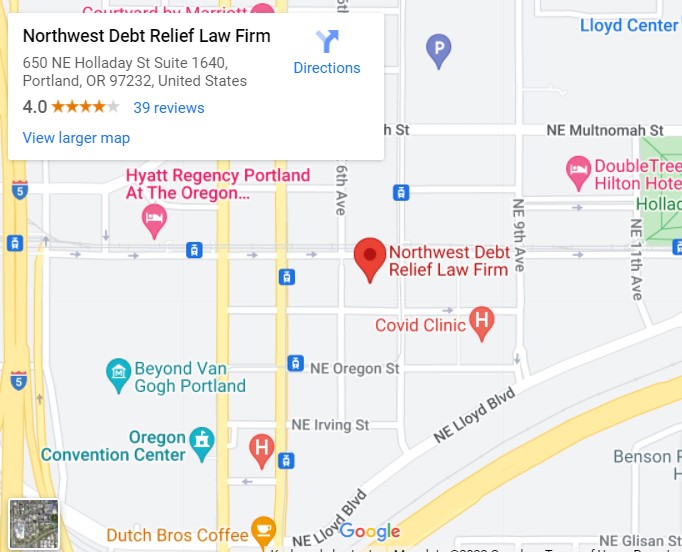
I’ve been a consumer bankruptcy lawyer since 2002, helping people get out of debt in both Washington and Oregon. I am the managing attorney of Northwest Debt Relief Law Firm. We have bankruptcy law offices in Vancouver, Washington and in both Portland and Salem, Oregon.

I grew up in Washington, D.C. but was lucky enough to move to the Pacific Northwest in 1995. When I am not practicing bankruptcy law, I spend the bulk of my time either on a yoga mat or with my wife and golden retriever, Mayzie.

+ Read the full Entry

May
18

List Every Debt in Your Bankruptcy

It can often be difficult to convince clients that that they need to include all of their debts in bankruptcy.  Generally this stems from the fear that if they list a house with a mortgage or a car with a car loan, they will lose their car or home in the bankruptcy proceeding  

The confusion stems from the difference between scheduling a debt and discharging the debt.  Debtors are required to list all their debts; however, debts are not necessarily discharged just because they are listed.  For example, the Bankruptcy Code specifies a number of debts that cannot be discharged in bankruptcy.  Those debts must, however, still be listed on the Schedules of the bankruptcy petition.   

+ Read the full Entry

May
13

What is a Lien?

The determination of whether a debt is secured or unsecured hinges on whether there is a lien with respect to the property. 

In general terms, a lien is a claim against specific property. Typically, the claim belongs to the person or the business that is owed a debt, usually a debt related to the property. It is sometimes called a “security interest”. A lien may be consensual, meaning that a person owning property agreed to having a lien against it. A lien may be involuntary, meaning that the lien was created either by a governmental entity or by a person authorized to create a lien by law.

+ Read the full Entry